Final project report
Eye care and hope for children in Narok, Kenya
This report describes the implementation and impact of the eye care project ‘The right to sight’ in Narok County, Kenya, from June 2025 to February 2026.
- Period
- June 2025 – February 2026
- Region
- Narok County, Kenya
Results in numbers
- children screened
- 6,000
- At schools in Narok County
- glasses provided
- 1,000
- Made locally by Namunyak Opticians
- medications provided
- 800
- For eye conditions
- professionals trained
- 300
- Teachers, opticians and health workers
The project improved access to eye care for children and the community in a region where such care is scarce. By combining preventive screening, direct treatment and specialist eye surgery, it delivered an integrated approach to both immediate needs and long-term capacity building.
A key milestone was the introduction of specialist oculoplastic and orbital surgery under the supervision of Prof. Dr. Maarten P. Mourits, together with the medical team of AIC Litein Hospital. Parents, teachers and village leaders expressed their appreciation for the care provided.
Background
In rural Narok County, quality eye care is severely limited. Many children grow up with untreated vision problems that hold back their learning and development. Without systematic screening, these problems often go unnoticed for years.
Approach: four pillars
- 1
School screening
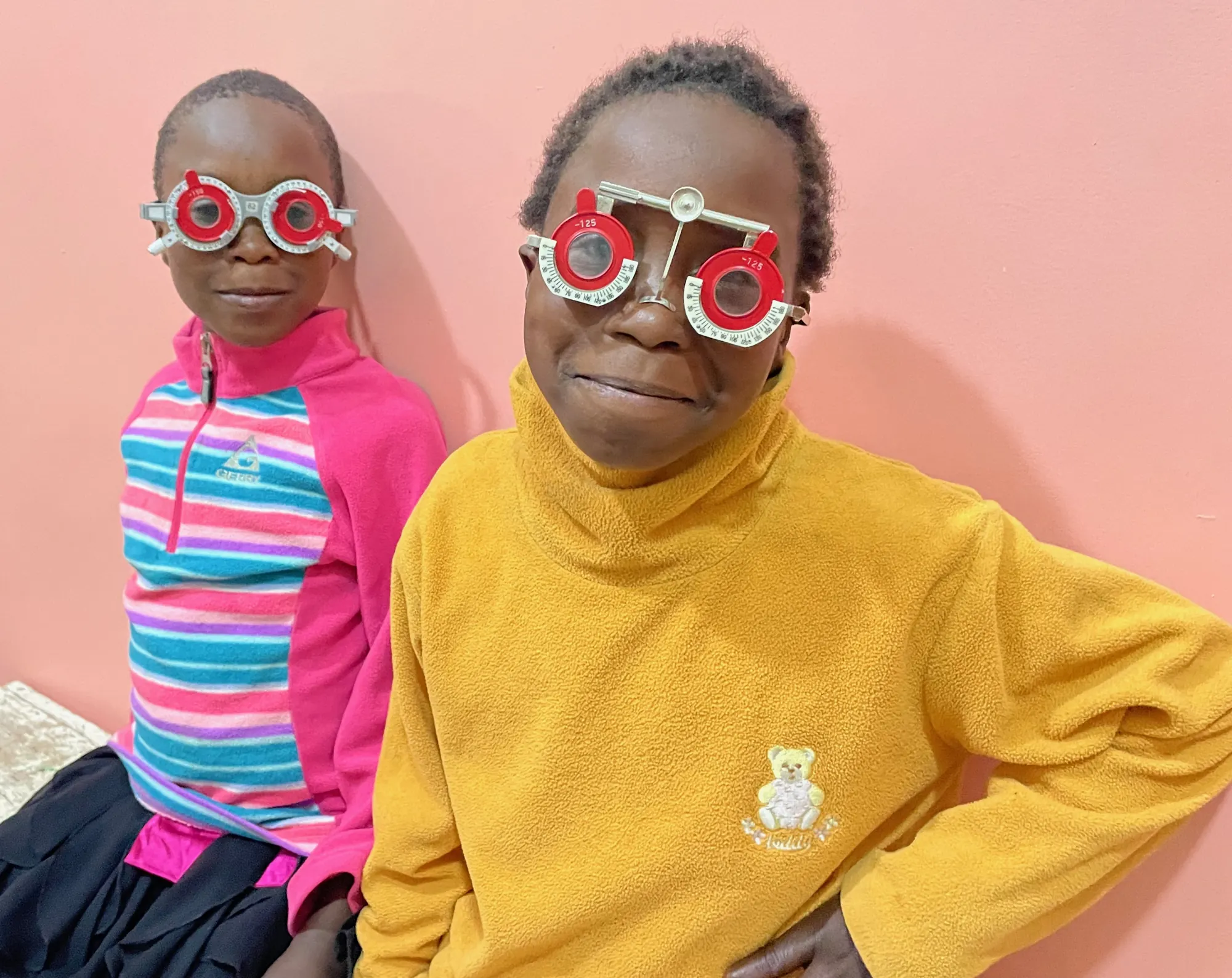
Large-scale screening at multiple schools: visual acuity tests and basic eye exams, so problems are found early.
Early diagnosis prevents lasting impairment
- 2
Treatment and glasses
Immediate care: glasses and medical treatment. Glasses were made locally by Namunyak Opticians, so they were available quickly.
Directly better concentration and learning
- 3
Specialist surgery
Complex conditions were referred to AIC Litein Hospital for oculoplastic and orbital surgery under the supervision of Prof. Dr. M.P. Mourits.
Life-changing treatment in the region
- 4
Capacity building
Training for teachers, health professionals and the surgical team, so eye care continues sustainably.
About 10 operations a month, performed independently
Procedures performed
For the first time, complex eye operations could be performed in the region, with better outcomes and fewer complications. The local team can now independently perform about 10 operations a month, around 120 a year.
| Procedure | Count |
|---|---|
| DCR (dacryocystorhinostomy) | 3 |
| Frontalis suspension | 1 |
| Levator reinsertion | 1 |
| Levator disinsertion | 1 |
| Ptosis correction | 1 |
| Canaliculitis treatment | 1 |
| Canthus correction | 1 |
| Entropion correction | 1 |
| Distichiasis treatment | 1 |
| Total | 11 |
Impact at several levels
For children
Thousands of children gained better vision, contributing to better concentration, learning and participation in class.
For the community
Greater awareness of eye health: parents, teachers and leaders recognise eye problems earlier and seek help in time.
For the health system
Training teachers, opticians, health workers and the surgical team expanded expertise in the region. Oculoplastic surgery structurally broadened the treatments available.
Strengthening Namunyak Opticians
The project contributed to a financially sustainable local care model. The local optician ensures glasses and eye care remain available in the region.
Exchange rate: KES 140 per euro
Before the project (2024)
€9,475
KES 1,326,600
After the project (2025–2026)
€24,907
KES 3,487,010
+163%
revenue growth in one project year
What the community says
Many vision problems previously went unnoticed. The screening and treatment have brought a direct improvement in the daily functioning of our children.
We clearly see better concentration, active participation and improved results among pupils who received glasses or treatment.
Specialist eye surgery in our region was something we never expected.
From the field
Watch the project
The next step
More screening
Reaching more schools and communities, including neighbouring regions.
Surgical capacity
Enabling the local team to perform increasingly complex procedures independently.
Embedding knowledge
Ongoing training of local professionals for quality and continuity.
This project shows that sustainable eye care in rural areas is achievable by combining screening, treatment, surgery and capacity building. We sincerely thank all donors for their essential contribution.